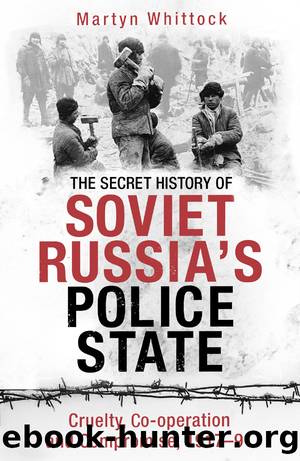
The Secret History of Soviet Russiaâs Police State by Martyn Whittock
Author:Martyn Whittock
Language: eng
Format: epub
Publisher: Little, Brown Book Group
Others simply passed on the warning: âKolyma znaczit smertâ (Kolyma means death). Here there were gold mines, coal mines, logging operations. Within a year, many prisoners were dokhodyaga (goners), worn out by hard work, poor food, the cold of winter and mosquito-plagued summers, and by brutal treatment. Among themselves, prisoners often referred to this as katorga (hard labour), a term dating from tsarist times. During the Great Patriotic War (1941â5) the term was even used officially to describe the work regime in camps for those designated as âwar criminalsâ. Among those worked to death in the Kolyma region was Mikhail Kravchuk, an acclaimed mathematician. As well as a human tragedy, such a prisoner was an immense loss to Soviet science. He was a very expensive labourer. The total number of prisoners passing through Kolyma between 1930 and 1953 was somewhere in the region of 2 million, probably more. How many died is extremely hard to determine and estimates vary hugely, ranging from 250,000 to more than 1 million fatalities.20
Anywhere in the USSR, convicts could be found labouring on many enterprises, ranging from gold mines to logging camps in the vast expanse of the taiga, railway construction to Pacific fishing camps, Moscow camps where engineers designed aircraft to agricultural camps in Uzbekistan. Brilliant scientists might be worked to death as convict labourers in the frozen north or in Kolyma, or their skills might cause them to be employed in a sharashka, a Gulag research and development laboratory. The variety was enormous and the secret police presided over a slave empire of vast proportions.
Conditions in the camps and sub-camps varied greatly, depending on the character and the whim of the local camp boss, and the regime he encouraged among the guards. One prisoner might find themselves hounded to destruction by a sadistic guard; another prisoner might find a guard inexplicably saved their life. The Polish prisoner, Jan Lewcun, was arrested in 1940 (his âcrimeâ was being Polish and capable of hard labour) and was eventually confined in a gold-mining camp in the Kolyma region. When his bread ration was stolen by another prisoner, he knew he was doomed and sat by the fence, waiting to be shot, to end the suffering. A passing guard called to him, âPick up the shovel and start working, but be here the next time I come around.â When the guard returned, he tossed a packet of meat sandwiches over the fence. Jan Lewcun survived.21
Life and death could seem quite arbitrary and dictated by factors beyond a prisonerâs control. In 1937â8, many camps were virtual death camps. But this changed noticeably, in 1939, with the fall of Yezhov and his replacement by Beria, and a reinstatement of economic productivity as a campâs objective, instead of the swift elimination of prisoners which had so characterised the height of the Yezhovshchina.22 These changes in priorities affected the lives of millions of zeks, who were at the receiving end of policies decided in Moscow. Conditions across the Gulag would change
Download
This site does not store any files on its server. We only index and link to content provided by other sites. Please contact the content providers to delete copyright contents if any and email us, we'll remove relevant links or contents immediately.
Personalized inhaled bacteriophage therapy for treatment of multidrug-resistant Pseudomonas aeruginosa in cystic fibrosis by unknow(213994)
CONSORT 2025 statement: updated guideline for reporting randomized trials by unknow(102518)
Critical evaluation of the ProfiLER-02 study design and outcomes by Vivek Subbiah & Razelle Kurzrock(102042)
Cardiac gene therapy makes a comeback by Oliver J. Müller & Susanne Hille & Anca Kliesow Remes(101836)
Whisky: Malt Whiskies of Scotland (Collins Little Books) by dominic roskrow(74617)
Unveiling the design rules for tunable emission in graphene quantum dots: A high-throughput TDDFT and machine learning perspective by Şener Özönder & Mustafa Coşkun Özdemir & Caner Ünlü(51000)
A yeast-based oral therapeutic delivers immune checkpoint inhibitors to reduce intestinal tumor burden by unknow(40371)
Covalent hitchhikers guide proteins to the nucleus by Alexander F. Russell & Madeline F. Currie & Champak Chatterjee(40295)
Meet the Authors: Christopher R. Mansfield and Emily R. Derbyshire by Christopher R. Mansfield & Emily R. Derbyshire(40204)
Alkaline-earth metals promote propane dehydrogenation with carbon dioxide through geometric effects: Altering the reaction pathway by unknow(32813)
Induced iron vacancies boosting FeOOH loaded on sustainable Fenton-like collagen fiber membrane for efficient removal of emerging contaminants by unknow(32609)
Efficient electric-field-assisted photochemical conversion of methane to n-propanol exclusively over penetrated TiO2Ti hollow fibers by Guanghui Feng(32528)
Bi2SiO5 nanosheets as piezo-photocatalyst for efficient degradation of 2,4-Dichlorophenol by Hangyu Shi & Yifu Li & Lishan Zhang & Guoguan Liu & Qian Zhang & Xuan Ru & Shan Zhong(32465)
A novel NDIPTA organic heterojunction photocatalyst with built-in electric field for efficient hydrogen production by Jiahui Yang & Baojun Ma & Yongfa Zhu(32438)
Enhanced conversion of methane to liquid-phase oxygenates via hollow ferrite nanotube@horseradish peroxidase based photoenzymatic catalysis by Jun Duan & Shiying Fan & Xinyong Li & Shaomin Liu(32404)
Ordered macroporous superstructure of defective carbon adorned with tiny cobalt sulfide for selective electrocatalytic hydrogenation of cinnamaldehyde by Xiao-Shi Yuan & Sheng-Hua Zhou & San-Mei Wang & Wenbo Wei & Xiaofang Li & Xin-Tao Wu & Qi-Long Zhu(32331)
What's Done in Darkness by Kayla Perrin(27246)
Topological analysis of non-conjugated ethylene oxide cored dendrimers decorated with tetraphenylethylene: Insights from degree-based descriptors using the polynomial approach by A Theertha Nair & D Antony Xavier & Annmaria Baby & S Akhila(26628)
Investigation of mechanical and self-healing properties of hydroxyl-terminated polybutadiene functionalized with 2-ureido-4-pyrimidinone by Mohsen Kazazi & Mehran Hayaty & Ali Mousaviazar(26554)
